
Category: Architecture

  • Monolith vs Microservices: Which Architecture Should You Choose?

    Monolith vs Microservices: Which Architecture Should You Choose?

    One of the most common architecture debates is:

    Should I build a Monolith or Microservices?

    Many developers assume microservices are always the better choice because large companies like Netflix, Amazon, and Uber use them.

    The reality?

    Most applications don’t need microservices on day one.

    Let’s compare both approaches.


    What Is a Monolithic Architecture?

    In a monolithic application, all modules—such as authentication, products, orders, and payments—are part of a single application and are deployed together.

    Advantages

    ✅ Simple to develop and deploy.

    ✅ Easier to debug.

    ✅ Lower operational complexity.

    ✅ Faster to get started.

    Challenges

    • Scaling means scaling the entire application.
    • A bug in one module can affect the whole system.
    • Large codebases become harder to maintain over time.

    What Are Microservices?

    In a microservices architecture, the application is divided into independent services.

    For example:

    • Authentication Service
    • Order Service
    • Product Service
    • Payment Service

    Each service can be developed, deployed, and scaled independently.

    Advantages

    ✅ Independent deployments.

    ✅ Scale only the services that need it.

    ✅ Better fault isolation.

    ✅ Teams can work independently.

    Challenges

    • More complex infrastructure.
    • Service-to-service communication.
    • Distributed logging and monitoring.
    • Data consistency across services.
    • Higher operational cost.

    When Should You Choose a Monolith?

    A monolith is often the better choice when:

    • You’re building a new product or MVP.
    • The team is small.
    • Requirements are still evolving.
    • Deployment simplicity is important.

    A well-designed modular monolith can support significant growth before microservices become necessary.


    When Should You Choose Microservices?

    Microservices become more valuable when:

    • Different parts of the system have different scaling needs.
    • Multiple teams work independently.
    • Independent deployments are required.
    • The application has grown too large for a single codebase.

    Comparison

    FeatureMonolithMicroservices
    DeploymentSingle deploymentIndependent deployments
    ScalabilityEntire applicationIndividual services
    ComplexityLowerHigher
    DevelopmentEasier initiallyMore planning required
    Team CollaborationBetter for small teamsBetter for multiple teams
    InfrastructureSimpleMore complex

    My Rule of Thumb

    • Small to medium applications: Start with a modular monolith.
    • Large, rapidly growing systems with multiple teams: Consider microservices when there is a clear business or technical need.

    Choosing microservices too early can introduce unnecessary complexity.


    Final Thoughts

    Architecture isn’t about following trends.

    It’s about solving the right problem with the right level of complexity.

    A well-structured monolith is often a better choice than poorly designed microservices.

    Start simple, measure your application’s needs, and evolve your architecture when the benefits outweigh the added complexity.
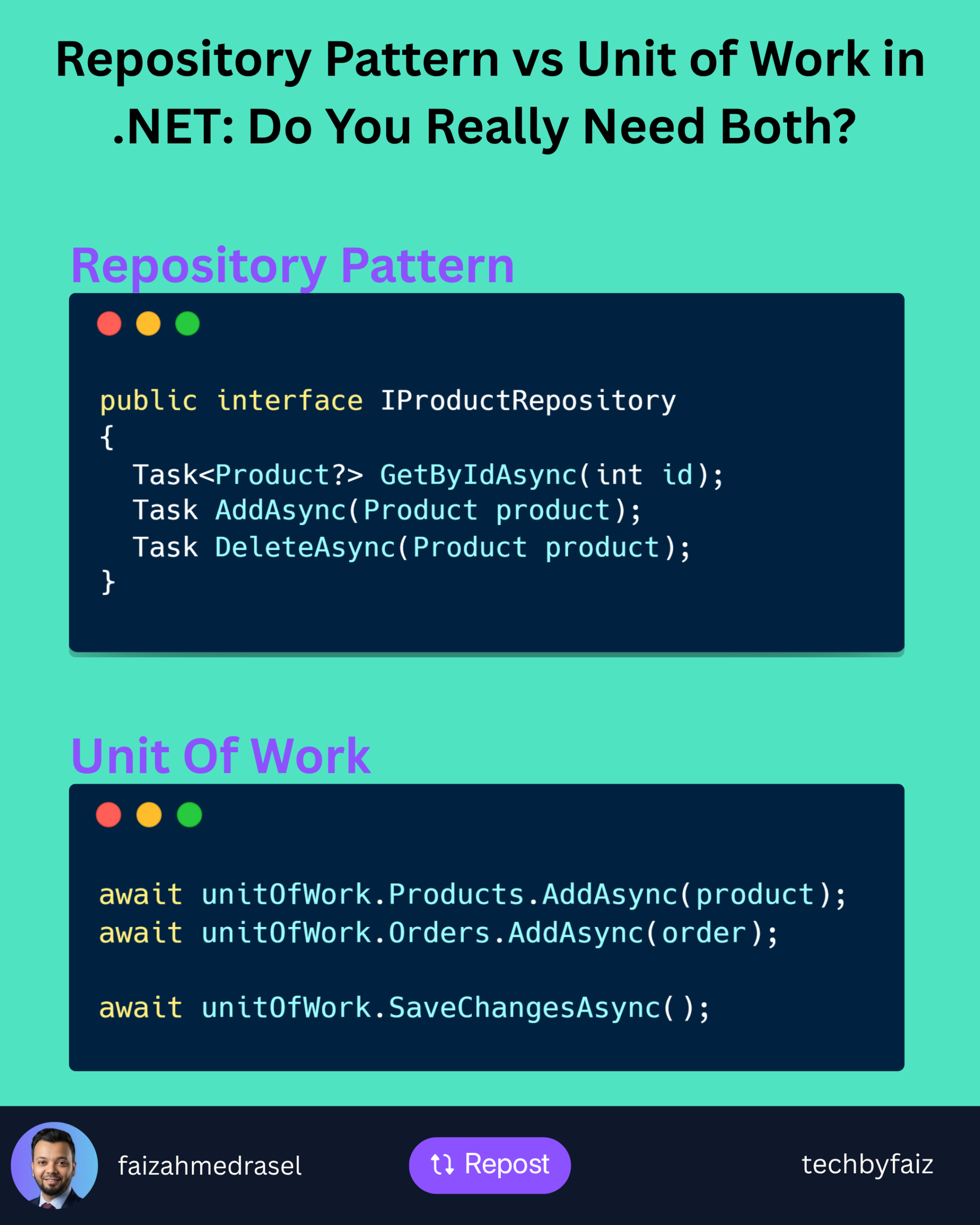
  • Repository Pattern vs Unit of Work in .NET: Do You Really Need Both?

    Repository Pattern vs Unit of Work in .NET: Do You Really Need Both?

    If you’ve worked on ASP.NET Core projects, you’ve probably seen classes like:

    • CustomerRepository
    • OrderRepository
    • UnitOfWork

    But with Entity Framework Core, an important question arises:

    Do we still need Repository and Unit of Work, or is DbContext enough?

    The answer depends on your application’s complexity and architectural goals.


    What Is the Repository Pattern?

    A Repository acts as an abstraction between your business logic and the data access layer.

    Instead of writing database queries throughout your application, all data operations are centralized.

    Example:

    public interface IProductRepository
    {
        Task<Product?> GetByIdAsync(int id);
        Task AddAsync(Product product);
        Task DeleteAsync(Product product);
    }
    

    The service interacts with the repository instead of directly with Entity Framework.

    Benefits

    • Separates business logic from data access.
    • Easier to mock during unit testing.
    • Centralizes reusable queries.
    • Improves maintainability in large projects.

    What Is the Unit of Work Pattern?

    The Unit of Work coordinates multiple repositories so they participate in a single transaction.

    Instead of saving changes after every repository operation, you commit them together.

    Example:

    await unitOfWork.Products.AddAsync(product);
    await unitOfWork.Orders.AddAsync(order);
    
    await unitOfWork.SaveChangesAsync();
    

    If one operation fails, the entire transaction can be rolled back.


    Doesn’t EF Core Already Provide These?

    Yes—and this is where many developers get confused.

    DbSet<T> behaves much like a Repository

    It already provides methods such as:

    • Add()
    • Remove()
    • Find()
    • Update()

    DbContext behaves like a Unit of Work

    It:

    • Tracks entity changes.
    • Coordinates updates.
    • Executes a single SaveChanges() or SaveChangesAsync().
    • Wraps changes in a transaction when appropriate.

    Because of this, many developers consider custom Repository and Unit of Work implementations unnecessary for simple CRUD applications.


    When Should You Use Custom Repository and Unit of Work?

    They make sense when:

    • Your application is large and follows Clean Architecture or Domain-Driven Design (DDD).
    • Multiple data sources need a consistent abstraction.
    • You have complex queries reused across many services.
    • You want to isolate EF Core from the application layer.
    • You anticipate changing the data access technology in the future.

    When Might They Be Unnecessary?

    For smaller applications that use EF Core exclusively, adding generic repositories can introduce extra complexity without much benefit.

    In these cases, injecting DbContext directly into services is often simpler and perfectly acceptable.


    My Rule of Thumb

    • Small to medium CRUD applications: DbContext is usually enough.
    • Large enterprise applications: A well-designed Repository and Unit of Work layer can improve organization, testability, and maintainability.

    The important point isn’t to follow a pattern blindly—it’s to choose the level of abstraction your project actually needs.


    Final Thoughts

    Repository and Unit of Work are valuable patterns, but they’re not mandatory in every ASP.NET Core application.

    EF Core already implements many of their responsibilities.

    Before adding another abstraction layer, ask yourself:

    Does this simplify my application, or does it simply add more code to maintain?

    Good architecture isn’t about using more patterns—it’s about using the right patterns for the problem you’re solving.