If you’ve worked on ASP.NET Core projects, you’ve probably seen classes like:
CustomerRepositoryOrderRepositoryUnitOfWork
But with Entity Framework Core, an important question arises:
Do we still need Repository and Unit of Work, or is DbContext enough?
The answer depends on your application’s complexity and architectural goals.
What Is the Repository Pattern?
A Repository acts as an abstraction between your business logic and the data access layer.
Instead of writing database queries throughout your application, all data operations are centralized.
Example:
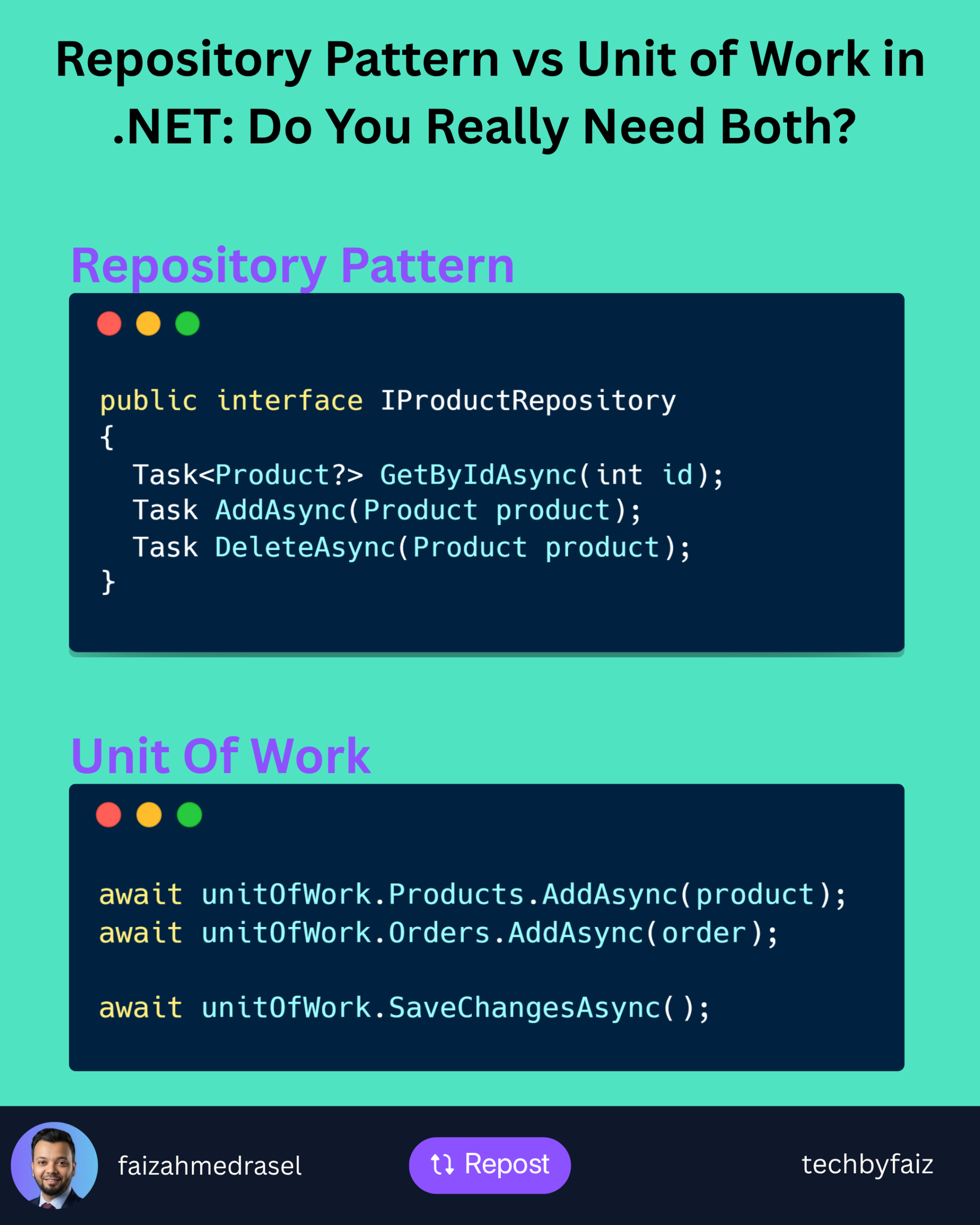
public interface IProductRepository
{
    Task<Product?> GetByIdAsync(int id);
    Task AddAsync(Product product);
    Task DeleteAsync(Product product);
}
The service interacts with the repository instead of directly with Entity Framework.
Benefits
- Separates business logic from data access.
- Easier to mock during unit testing.
- Centralizes reusable queries.
- Improves maintainability in large projects.
What Is the Unit of Work Pattern?
The Unit of Work coordinates multiple repositories so they participate in a single transaction.
Instead of saving changes after every repository operation, you commit them together.
Example:
await unitOfWork.Products.AddAsync(product);
await unitOfWork.Orders.AddAsync(order);

await unitOfWork.SaveChangesAsync();
If one operation fails, the entire transaction can be rolled back.
Doesn’t EF Core Already Provide These?
Yes—and this is where many developers get confused.
DbSet<T> behaves much like a Repository
It already provides methods such as:
Add()Remove()Find()Update()
DbContext behaves like a Unit of Work
It:
- Tracks entity changes.
- Coordinates updates.
- Executes a single
SaveChanges()orSaveChangesAsync(). - Wraps changes in a transaction when appropriate.
Because of this, many developers consider custom Repository and Unit of Work implementations unnecessary for simple CRUD applications.
When Should You Use Custom Repository and Unit of Work?
They make sense when:
- Your application is large and follows Clean Architecture or Domain-Driven Design (DDD).
- Multiple data sources need a consistent abstraction.
- You have complex queries reused across many services.
- You want to isolate EF Core from the application layer.
- You anticipate changing the data access technology in the future.
When Might They Be Unnecessary?
For smaller applications that use EF Core exclusively, adding generic repositories can introduce extra complexity without much benefit.
In these cases, injecting DbContext directly into services is often simpler and perfectly acceptable.
My Rule of Thumb
- Small to medium CRUD applications:
DbContextis usually enough. - Large enterprise applications: A well-designed Repository and Unit of Work layer can improve organization, testability, and maintainability.
The important point isn’t to follow a pattern blindly—it’s to choose the level of abstraction your project actually needs.
Final Thoughts
Repository and Unit of Work are valuable patterns, but they’re not mandatory in every ASP.NET Core application.
EF Core already implements many of their responsibilities.
Before adding another abstraction layer, ask yourself:
Does this simplify my application, or does it simply add more code to maintain?
Good architecture isn’t about using more patterns—it’s about using the right patterns for the problem you’re solving.