As C# developers, we often need to make decisions in our code.
Two common ways to do this are:
if-else- The ternary operator (
?:)
Both achieve the same goal, but choosing the right one can make your code either easier—or harder—to read.
Let’s explore when each approach is the better choice.
Using if-else
The if-else statement is ideal when the logic is more than a simple decision.
Example:
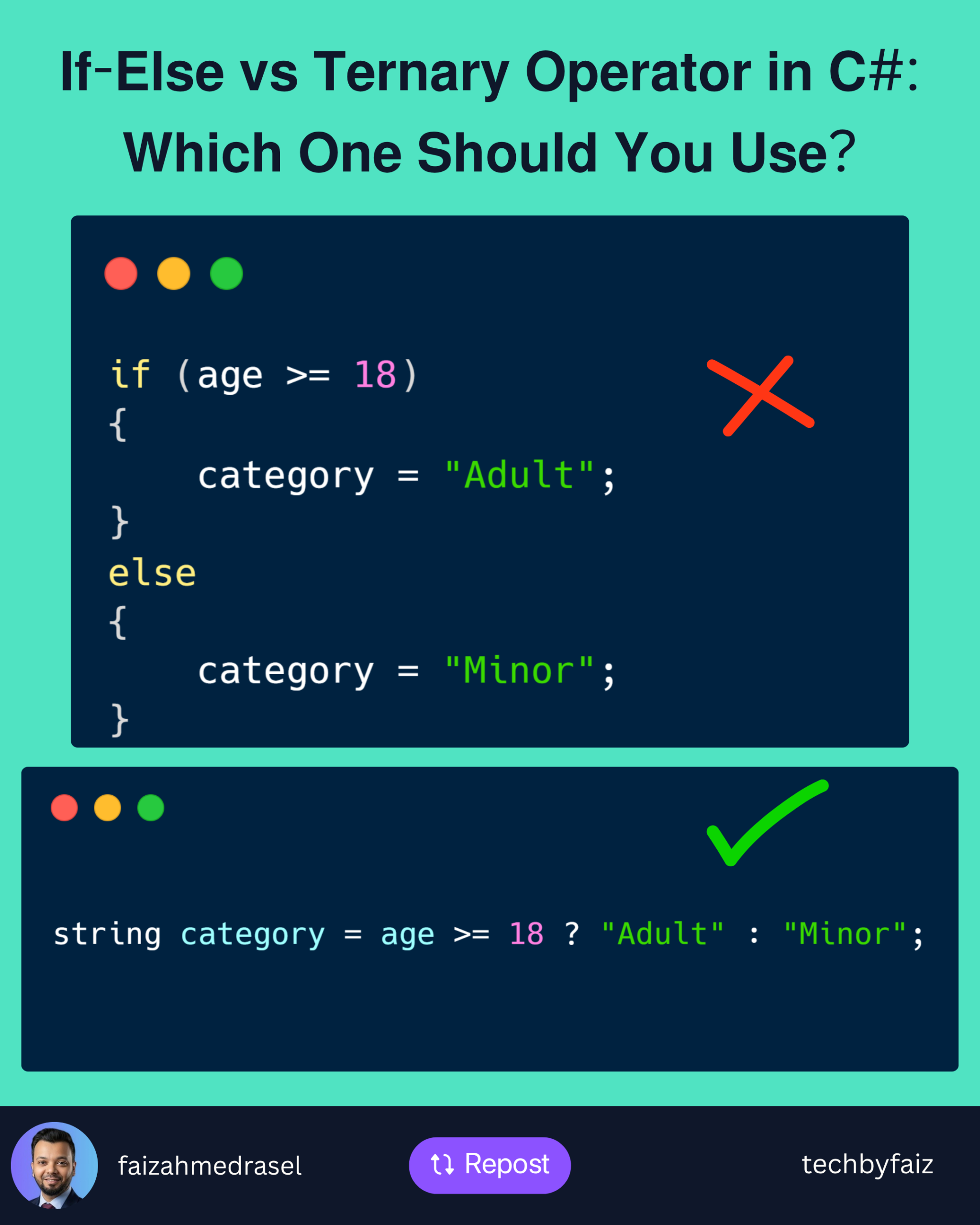
if (age >= 18)
{
    category = "Adult";
}
else
{
    category = "Minor";
}
This style is easy to understand, especially when additional conditions or multiple statements are involved.
When to Use if-else
Use if-else when:
- You have multiple statements to execute.
- The logic is complex.
- You need nested conditions.
- Readability is more important than brevity.
Using the Ternary Operator
The ternary operator provides a shorter way to assign a value based on a condition.
Syntax:
condition ? valueIfTrue : valueIfFalse;
Example:
string category = age >= 18 ? "Adult" : "Minor";
This is concise, expressive, and easy to read.
A Good Use Case
The ternary operator works well for simple value assignments.
string status = isActive ? "Active" : "Inactive";
Simple.
Readable.
No unnecessary lines of code.
A Bad Use Case
Avoid chaining multiple ternary operators.
string result = score >= 80
    ? "Excellent"
    : score >= 60
        ? "Good"
        : score >= 40
            ? "Average"
            : "Fail";
Although valid, this quickly becomes difficult to read and maintain.
An if-else block communicates the same logic much more clearly.
Comparison
| Scenario | Recommended |
|---|---|
| Simple value assignment | ✅ Ternary Operator |
| Multiple statements | ✅ If-Else |
| Complex business logic | ✅ If-Else |
| Nested conditions | ✅ If-Else |
| Short, readable conditions | ✅ Ternary Operator |
Best Practices
✔ Use the ternary operator only for simple expressions.
✔ Prefer if-else for complex decision-making.
✔ Avoid deeply nested ternary operators.
✔ Prioritize readability over writing fewer lines of code.
Remember:
Code is read far more often than it is written.
Final Thoughts
The ternary operator is a great tool—but like any tool, it should be used appropriately.
If it makes your code clearer, use it.
If it makes someone stop and think, an if-else statement is probably the better choice.
The goal isn’t to write the shortest code—it’s to write code that’s easy for your future self and your teammates to understand.
Leave a Reply