When building ASP.NET Core Web APIs, one of the most common questions is:
Should I return IActionResult, ActionResult, or ActionResult<T> from my controller actions?
Although they seem similar, each serves a different purpose. Choosing the right one makes your API more readable, maintainable, and expressive.
What is IActionResult?
IActionResult is an interface that represents the result of an action method.
It allows your action to return different types of HTTP responses.
Example:
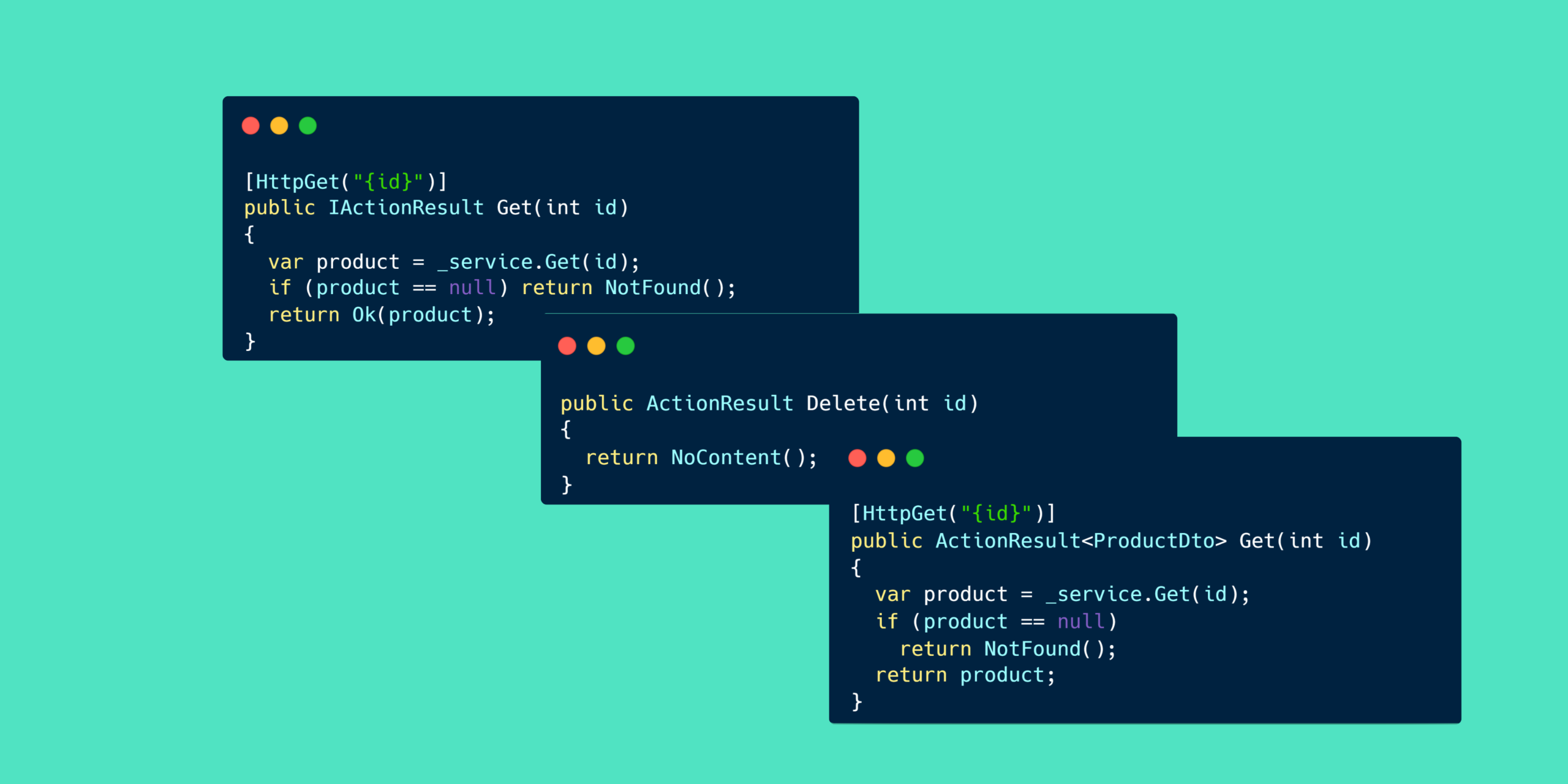
[HttpGet("{id}")]
public IActionResult Get(int id)
{
    var product = _service.Get(id);

    if (product == null)
        return NotFound();

    return Ok(product);
}
Since both NotFound() and Ok() implement IActionResult, the method can return either response.
When to use IActionResult
- Multiple possible HTTP responses
- Endpoints that don’t return a specific model
- File downloads
- Redirects
- Custom response logic
What is ActionResult?
ActionResult is a concrete implementation of IActionResult.
In practice, it behaves similarly, but most developers now prefer either IActionResult or ActionResult<T> depending on the scenario.
Example:
public ActionResult Delete(int id)
{
    return NoContent();
}
For actions that don’t return a data model, ActionResult is perfectly valid.
What is ActionResult<T>?
ActionResult<T> combines a strongly typed response model with the flexibility to return HTTP status codes.
Example:
[HttpGet("{id}")]
public ActionResult<ProductDto> Get(int id)
{
    var product = _service.Get(id);

    if (product == null)
        return NotFound();

    return product;
}
Notice that when the request succeeds, you can simply return the model.
ASP.NET Core automatically wraps it in a 200 OK response.
If something goes wrong, you can still return NotFound(), BadRequest(), or any other HTTP result.
Comparison
| Feature | IActionResult | ActionResult | ActionResult |
|---|---|---|---|
| Returns different HTTP responses | ✅ | ✅ | ✅ |
| Strongly typed response | ❌ | ❌ | ✅ |
| Better API documentation | ❌ | ❌ | ✅ |
| Works well with Swagger/OpenAPI | Limited | Limited | Excellent |
Which One Should You Choose?
Use IActionResult when:
- Returning files
- Redirecting users
- Returning different response formats
- No specific response model exists
Use ActionResult
- Simple endpoints without a response model
- Commands such as Delete or Update that mainly return status codes
Use ActionResult<T>
- REST APIs returning DTOs
- CRUD endpoints
- APIs documented with Swagger/OpenAPI
- Most modern ASP.NET Core Web APIs
Best Practice
For APIs that return data, prefer ActionResult<T>.
It provides:
- Strong typing
- Better IntelliSense
- Cleaner code
- Improved Swagger documentation
- Clearer API contracts
Use IActionResult when your action’s primary purpose is to return different kinds of responses rather than a specific model.
Final Thoughts
There isn’t a single “best” return type.
The right choice depends on what your endpoint is designed to return.
As a general guideline:
- Returning data? →
ActionResult<T> - Returning only status codes? →
ActionResult - Returning multiple response types (files, redirects, custom results)? →
IActionResult
Choosing the appropriate return type makes your API easier to understand for both developers and API consumers.
Leave a Reply