When developing enterprise applications, one common challenge is managing dependencies between different components.
A tightly coupled application becomes difficult to maintain because changing one component may require changes across multiple areas of the system.
Dependency Injection (DI) is a design pattern that helps solve this problem by creating loosely coupled, testable, and maintainable applications.
What is Dependency Injection?
Dependency Injection is a technique where an object receives its required dependencies from an external source instead of creating them internally.
In simple words:
A class should not create the objects it depends on. Instead, those objects should be provided to it.
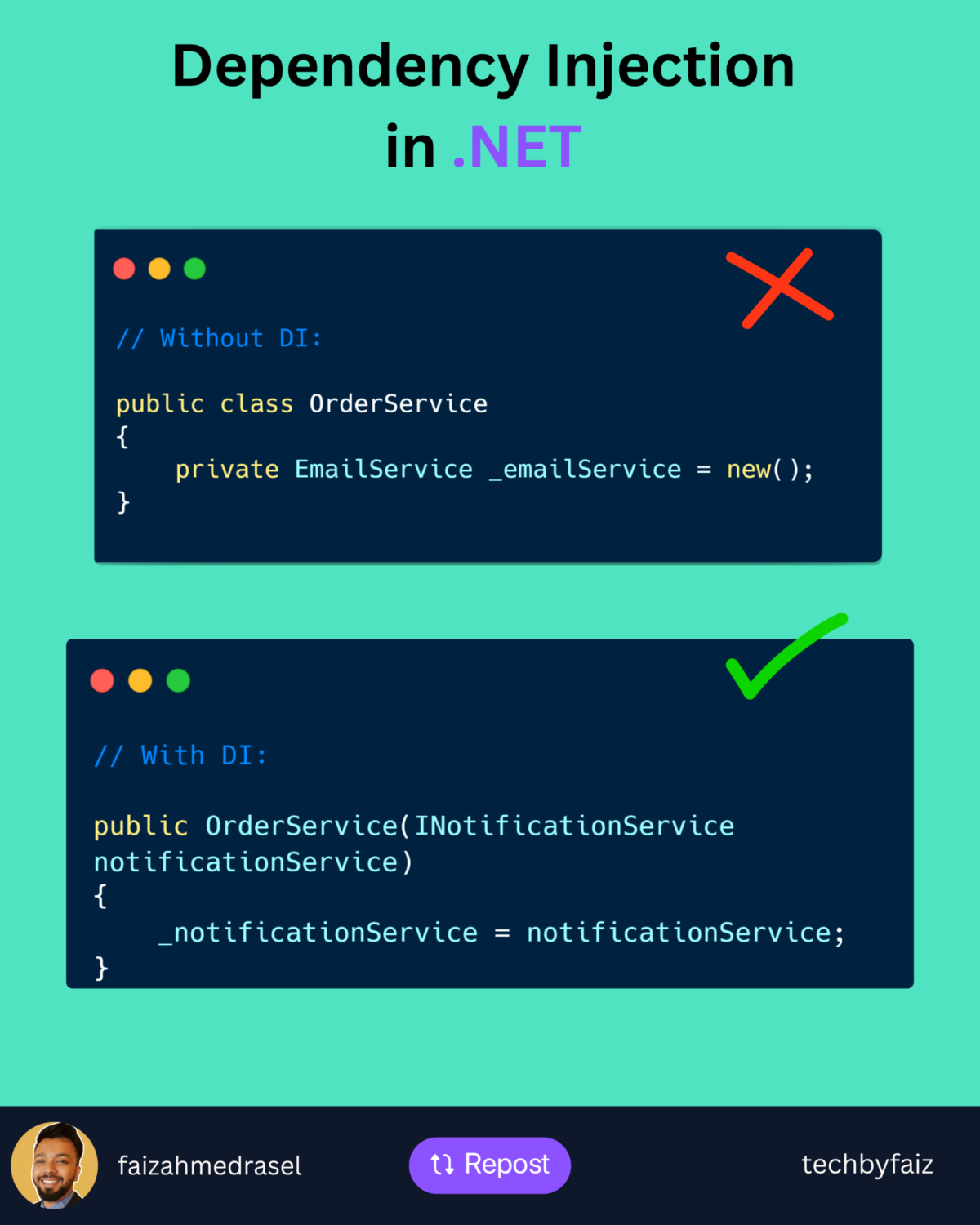
Without Dependency Injection
Example:
public class OrderService
{
    private readonly EmailService _emailService;

    public OrderService()
    {
        _emailService = new EmailService();
    }

    public void PlaceOrder()
    {
        _emailService.SendEmail();
    }
}
Here, OrderService directly creates an instance of EmailService.
Problems:
- Tight coupling
- Difficult unit testing
- Hard to replace implementations
- Less flexible architecture
Imagine tomorrow the business wants SMS notification instead of email. We need to modify the OrderService class.
With Dependency Injection
Using an abstraction:
public interface INotificationService
{
    void Send(string message);
}

public class OrderService
{
    private readonly INotificationService _notificationService;

    public OrderService(INotificationService notificationService)
    {
        _notificationService = notificationService;
    }

    public void PlaceOrder()
    {
        _notificationService.Send("Order completed");
    }
}
Now OrderService does not care whether the notification is sent by email, SMS, or another service.
It only depends on the contract.
Benefits of Dependency Injection
1. Loose Coupling
Classes depend on abstractions rather than concrete implementations.
2. Better Testability
Dependencies can easily be replaced with mock objects during unit testing.
3. Better Maintainability
New implementations can be added without modifying existing business logic.
4. Improved Scalability
Large applications become easier to manage when components are independent.
Dependency Injection Lifetimes in ASP.NET Core
ASP.NET Core provides three built-in lifetimes.
Transient
A new instance is created every time the service is requested.
Suitable for lightweight, stateless services.
services.AddTransient<IEmailService, EmailService>();
Scoped
One instance is created per HTTP request.
Commonly used for database-related services.
services.AddScoped<IOrderService, OrderService>();
Singleton
A single instance exists throughout the application lifetime.
Useful for caching or configuration services.
services.AddSingleton<ICacheService, CacheService>();
Common DI Mistakes
Some developers use DI without understanding service lifetimes.
Examples:
- Using Singleton with a Scoped dependency
- Registering everything as Singleton
- Creating unnecessary abstractions
DI is not only about registering services. It is about designing better software boundaries.
Final Thoughts
Dependency Injection is one of the fundamental concepts behind modern .NET application architecture.
It helps developers create applications that are easier to test, maintain, and extend.
Understanding DI properly is essential for building scalable enterprise applications.
Leave a Reply